


When Microsoft announced its $7.5 billion acquisition of ZeniMax Media -the parent company of Bethesda Softworks -in September 2020, the gaming world reacted with a mix of excitement and anxiety. Excitement, because Bethesda’s catalog reads like a greatest-hits list: The Elder Scrolls, Fallout, Doom, Dishonored, and Wolfenstein, among others. Anxiety, because history is full of studios that lost their creative spark the moment a corporate giant took over.
So the real story wasn’t just the deal itself. It was what Microsoft’s top leaders said afterward, as they tried to convince players, developers, and industry watchers that this acquisition would be different.
The Deal That Shook the Industry
Microsoft confirmed the acquisition on September 21, 2020, folding in eight studios under the Bethesda umbrella -Bethesda Game Studios, id Software, ZeniMax Online Studios, Arkane, MachineGames, Tango Gameworks, Alpha Dog, and Roundhouse Studios. Together, these studios employed more than 2,300 people worldwide.
Microsoft CEO Satya Nadella framed the purchase as central to the company’s broader gaming ambitions, tying it directly to the growth of Xbox Game Pass. Xbox chief Phil Spencer, meanwhile, called it an investment in “the most critical part of our strategy: the games,” pointing to Bethesda’s decades-long track record of blockbuster franchises.
The acquisition officially closed in March 2021.
Addressing the Big Fear: Would Bethesda Lose Its Identity?
The immediate question from fans wasn’t about the money -it was about creative control. Would Bethesda’s writers, designers, and studio heads still get to make the games they wanted to make? Or would Microsoft start dictating terms the moment the ink dried?
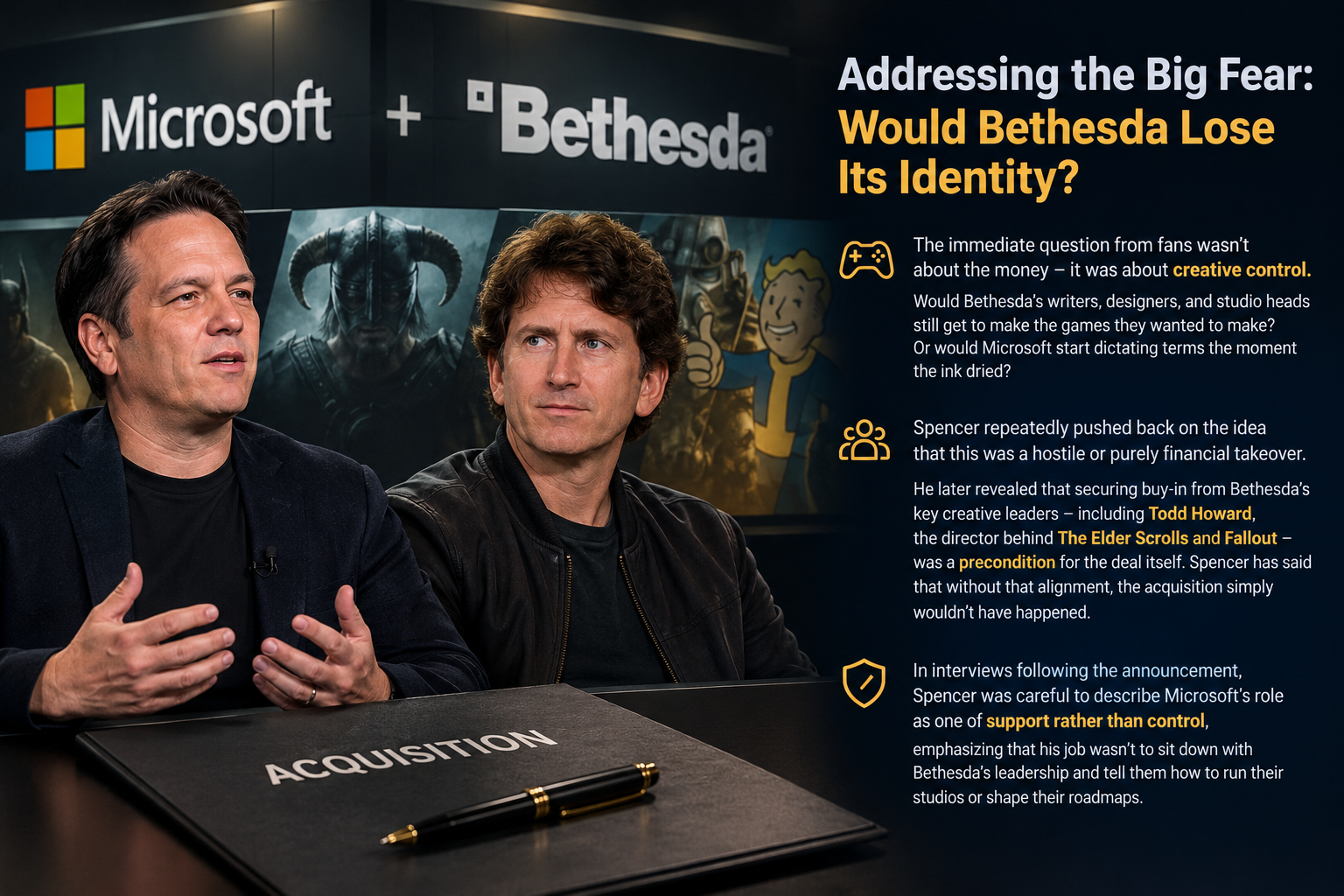

Spencer repeatedly pushed back on the idea that this was a hostile or purely financial takeover. He later revealed that securing buy-in from Bethesda’s key creative leaders -including Todd Howard, the director behind The Elder Scrolls and Fallout -was a precondition for the deal itself. Spencer has said that without that alignment, the acquisition simply wouldn’t have happened.
In interviews following the announcement, Spencer was careful to describe Microsoft’s role as one of support rather than control, emphasizing that his job wasn’t to sit down with Bethesda’s leadership and tell them how to run their studios or shape their roadmaps.
Would Bethesda Games Still Come to PlayStation and Switch?
This was the second major worry, and Microsoft’s answers evolved carefully over time.
Early on, Xbox leadership confirmed that existing agreements would be honored -meaning Deathloop and Ghostwire: Tokyo, both already promised as timed PlayStation exclusives, would still launch on Sony’s platform as planned.

For everything after that, the messaging shifted toward a “first, better, or best” philosophy rather than an outright exclusivity lockdown. Xbox CFO Tim Stuart explained that Microsoft had no plans to strip all Bethesda content away from Sony, Nintendo, or other platforms. Instead, the goal was to make sure Bethesda’s games showed up in their best possible form -and often first -on Xbox and Game Pass, using this as a lever to grow subscriber numbers.
That nuance mattered a lot to fans on other platforms, even if it left some ambiguity about individual future titles.
The Story Got More Complicated Later
Years later, during Microsoft’s court battle with the U.S. Federal Trade Commission over its separate Activision Blizzard acquisition, Spencer gave testimony that added new context to the original Bethesda deal. He explained that one of the real motivations behind buying ZeniMax was concern that Sony could pay to keep major Bethesda titles -like the highly anticipated Starfield -off Xbox entirely, the way it had with Deathloop and Ghostwire: Tokyo.
Spencer described the competitive pressure bluntly: every game shipped on PlayStation lets Sony capture a share of the revenue, some of which, in his view, gets used to strengthen Sony’s position against Xbox. Buying Bethesda was, in part, a way to secure exclusive content and remain competitive as what he called a “third-place console.”
This reframed the original “we won’t screw it up” reassurances in a more strategic light -the promise to preserve creative independence was real, but so was the business calculation behind the acquisition.
Where Things Stand Today
Starfield ultimately launched as an Xbox and PC exclusive, skipping PlayStation entirely -a decision that lines up with the “secure the content” reasoning Spencer described in his FTC testimony. Indiana Jones and the Great Circle, developed by Bethesda-owned MachineGames, followed a similar Xbox-and-PC-only release pattern.
At the same time, older Bethesda franchises have continued to appear on other platforms, and Microsoft has periodically brought back-catalog titles to PlayStation and Nintendo consoles through Game Pass-adjacent deals and standalone releases.
The Bigger Picture
Looking back, Microsoft’s promise not to “screw up” Bethesda held up in the ways that mattered most to the studios themselves -creative teams stayed largely intact, franchises kept shipping, and the acquisition didn’t trigger the kind of talent exodus or creative gutting that fans feared. Where the promise got more complicated was on the platform-availability side, where competitive pressure with Sony ultimately pushed Microsoft toward tighter exclusivity than its early messaging suggested.
For an industry watching Microsoft’s next moves -including its much larger Activision Blizzard acquisition -the Bethesda deal became something of a case study: proof that a big tech company could absorb a legendary game publisher without immediately breaking it, even if the platform politics around it stayed messy.