


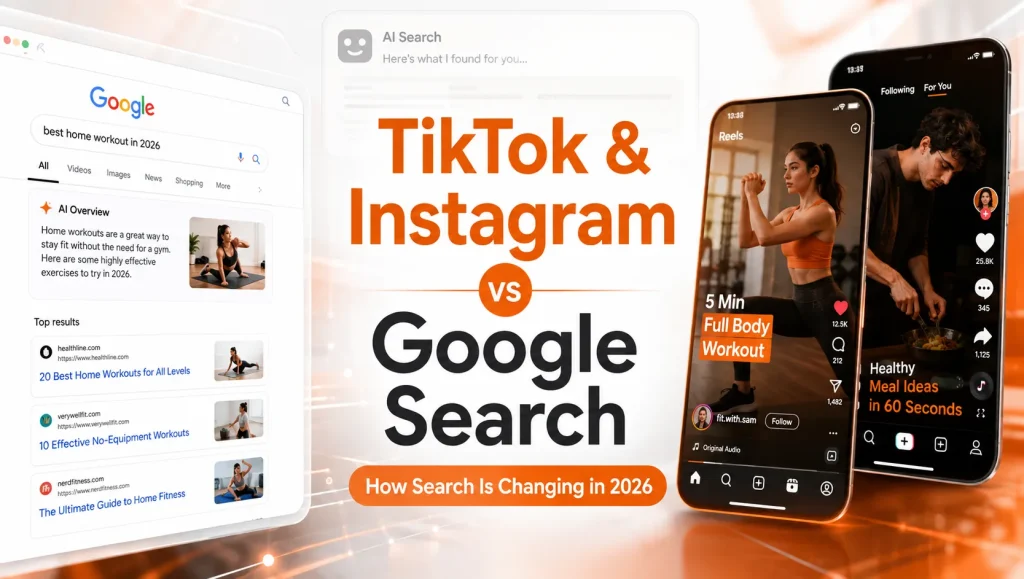
Google has been the default place to search for information on the internet for years. Whether someone wanted to find a restaurant, compare products, learn how to fix something, or find a nearby business, the usual process was simple: open Google, type a query, and browse the results.
But that behavior is changing.
In 2022, Google itself acknowledged that younger users were increasingly turning to platforms such as TikTok and Instagram instead of Google Search or Google Maps for certain types of discovery. Google SVP Prabhakar Raghavan said that in the company’s internal research, almost 40% of young people looking for a place for lunch went to TikTok or Instagram instead of Google Search or Maps. The research involved U.S. users aged 18–24.
Four years later, the idea is no longer just about TikTok and Instagram.
People now search across TikTok, Instagram, YouTube, Reddit, Google, and AI tools such as ChatGPT. The search journey has become more fragmented, especially among younger users.
So, is TikTok really replacing Google?
Not exactly.
Google is still extremely important, but users are no longer relying on one platform for every type of search. Instead, different platforms are becoming useful for different parts of the discovery process.
What Did Google Say About TikTok and Instagram in 2022?
The discussion started with comments made by Google’s Prabhakar Raghavan at Fortune’s Brainstorm Tech conference in 2022.
Raghavan explained that younger internet users were developing different search habits from older generations. Instead of always typing keywords into Google, they were increasingly looking for visual and immersive ways to discover information.
One example was local search.
According to Google’s internal research, almost 40% of young users looking for a place to eat were going to TikTok or Instagram instead of Google Search or Google Maps. Google later confirmed that the research involved U.S. users between 18 and 24 years old.
The important part of this statement was not simply the 40% number.
It showed that search behavior was changing.
A person searching for a restaurant on Google might look at ratings, reviews, opening hours, photos, and location.
On TikTok or Instagram, that same person might watch a 30-second video showing the restaurant’s food, atmosphere, prices, and customer experience.
Both platforms can answer the same basic question, but they do it in very different ways.
That difference is exactly where social search started becoming important.
2025–2026: Social Search Has Become a Bigger Part of Discovery
The shift identified by Google in 2022 has continued.
According to Sprout Social’s Q2 2025 Pulse Survey, 41% of Gen Z users turn to social media first when looking for information, compared with 32% who start with traditional search engines. The survey covered more than 2,200 social users in the U.S., UK, and Australia.
This doesn’t mean Gen Z has stopped using Google.
Instead, it shows that social media has become an important starting point for certain types of searches.
The difference becomes even clearer when we look at product discovery.
Sprout Social found that 37% of consumers prefer to use social media first when looking for product reviews and recommendations. For local restaurants and activities, 35% prefer social as their first destination.
That is important for marketers because these are searches that directly influence buying decisions.
Someone may discover a skincare product through an Instagram Reel, watch a TikTok review, search YouTube for a detailed comparison, and then visit Google to find the brand’s official website.
The search journey is no longer linear.
TikTok Is Being Used as a Search Engine
TikTok is one of the clearest examples of how search has changed.
Adobe Express reported in February 2026 that 49% of surveyed U.S. consumers had used TikTok as a search engine. That was up from 41% in Adobe’s 2024 survey, representing a 19.5% increase in adoption over two years.
Why are people doing this?
Because TikTok provides something traditional search results often cannot provide immediately: visual context.
For example, a user searching for:
- Best cafes in Delhi
- How to style wide-leg jeans
- Best budget smartphones
- Haircare routine for dry hair
- Things to do in Dubai
- Best places to eat near me
may prefer to see someone actually demonstrate or experience the answer.
Instead of reading ten webpages, users can watch several short videos and quickly compare opinions.
Adobe found that the short-video format, storytelling, and interactive experience are among the reasons people use TikTok instead of traditional search engines.
This is one reason social search works particularly well for discovery-based queries.
But Is Gen Z Actually Choosing TikTok Over Google?
This is where the data needs some context.
It would be inaccurate to say that Gen Z has completely moved from Google to TikTok.
Adobe’s 2026 research found that 89% of Gen Z respondents still preferred Google over other platforms as a search engine.
Only 4% said they were more likely to rely on TikTok than Google. That figure had fallen from 8% in 2024.
So the real story is more nuanced.
TikTok is becoming an important search and discovery platform, but Google has not simply disappeared from the picture.
People are choosing platforms based on what they want to find.
For example:
Google may be preferred for:
- Official information
- Websites and documents
- Detailed research
- Navigational searches
- Business information
- Complex queries
TikTok and Instagram may be preferred for:
- Product inspiration
- Restaurant discovery
- Fashion ideas
- Beauty recommendations
- Travel inspiration
- Real-world experiences
- Short tutorials
This means marketers shouldn’t think about social search as a simple “Google vs. TikTok” battle.
It is better understood as Google + social + video + communities + AI.
Instagram Is Also Becoming a Discovery Platform
TikTok isn’t the only social platform changing search behavior.
Instagram has also become an important discovery channel, particularly for visual industries such as fashion, food, travel, beauty, fitness, and local businesses.
A user searching for a restaurant may want to see its food before making a decision. A traveler may want to see what a destination actually looks like. Someone shopping for clothes may want to see how a product looks on a real person.
Instagram is naturally suited to these searches because its content is highly visual.
This creates a major opportunity for businesses.
A restaurant, for example, should not only think about ranking on Google Maps. Its Instagram profile can also act as a discovery page.
A customer may discover the restaurant through a Reel, check its profile, look at tagged posts, read comments, and then finally use Google Maps for directions.
In that journey, Google and Instagram are not necessarily competitors.
They are different parts of the same customer journey.
Local Search Is Changing Too
Local search is one of the areas where the TikTok and Instagram shift becomes especially interesting.
The original 2022 Google research was specifically connected to finding places to eat.
Today, users can discover local businesses through:
- TikTok videos
- Instagram Reels
- Instagram Maps and location features
- Google Business Profiles
- Google Maps
- YouTube videos
- Reddit discussions
- Customer reviews
For a local business, this means having a Google Business Profile alone may not be enough.
Imagine someone searching for “best coffee shop near me.”
They may first see a TikTok showing a café’s interior.
Then they may open Instagram to check its menu and photos.
After that, they may search the business on Google to confirm the location, opening hours, reviews, and directions.
The business needs to be visible across multiple touchpoints.
AI Is Adding Another Layer to Search
Social media isn’t the only thing changing search.
AI chatbots have also entered the search journey.
Adobe’s 2026 research found that 14% of surveyed consumers were more likely to rely on ChatGPT than Google as a search engine. Among Gen Z respondents, the figure was 12%.
This creates another major change for marketers.
A user may no longer search:
“best SEO tools 2026”
and simply click the first Google result.
Instead, they may ask an AI assistant:
“What are the best SEO tools for a small business with a limited budget?”
The answer may summarize multiple sources and recommend a few options.
That means visibility is no longer only about getting a blue link on Google.
Brands increasingly need to become useful, trustworthy and easy to understand across different discovery environments.
Google Has Been Adapting to the Change
Google has not ignored these behavioral changes.
Even in 2022, Google was already working on making Search more visual and useful for younger users.
Google was experimenting with ways to understand video content and surface richer visual results. It was also working on features such as multisearch, which combines text and images to help users search using what they see rather than relying only on typed keywords.
Google also acknowledged the importance of TikTok and Instagram content appearing in Search.
The company’s challenge is simple:
If users discover information somewhere else first, Google needs to make its own search experience useful enough to remain part of that journey.
This is why modern Google Search looks very different from the traditional list of ten blue links.
Search now includes images, videos, maps, shopping results, forums, local information, AI-generated answers, and many other formats.
What Does This Mean for SEO in 2026?
For SEO professionals, the biggest lesson is that search optimization can no longer stop at Google.
Traditional SEO still matters.
Websites still need:
- Useful content
- Good technical SEO
- Relevant keywords
- Strong internal linking
- Quality backlinks
- Clear website structure
- Good page experience
- Helpful information
But marketers should also think about social search optimization.
That means creating content that people can discover directly inside platforms such as TikTok, Instagram and YouTube.
1. Use Search-Friendly Language on Social Media
Don’t treat captions as an afterthought.
Use the phrases your audience actually searches for in:
- Video titles
- Captions
- On-screen text
- Descriptions
- Profile bios
- Spoken content
For example, instead of creating a generic video titled “Our New Collection,” a fashion brand could create:
“Best Plus-Size Party Dresses Under ₹2,000”
The second title gives both the user and the platform a much clearer idea of what the content is about.
2. Create Content Around Search Intent
The best social content often answers a specific question.
Examples include:
- How to choose the right laptop
- Best phones under ₹20,000
- How to fix slow Wi-Fi
- Best cafes in Karnal
- What to wear to a wedding
- SEO tips for beginners
These topics are useful because they match real search behavior.
3. Don’t Ignore Video SEO
Video content should also be searchable.
Use clear titles, relevant descriptions, captions and spoken keywords.
This is particularly important because social videos can also appear in traditional search results.
Sprout Social notes that social content increasingly appears in search engines, creating another opportunity for brands that optimize video content for discoverability.
4. Build Real Social Proof
People don’t only want brands to tell them that a product is good.
They want to see someone actually using it.
That is why reviews, customer videos, testimonials, creator content and user-generated content can be powerful.
Sprout Social’s research found that 76% of consumers said social media content had influenced some of their purchases during the previous six months. Among Gen Z, that figure rose to 90%.
For marketers, this means social media is not only an awareness channel.
It can influence consideration and purchasing decisions too.
5. Keep Google in the Strategy
The biggest mistake would be to see the rise of social search and completely abandon Google SEO.
The data doesn’t support that.
Adobe’s 2026 survey, for example, found that 89% of Gen Z respondents still preferred Google over other platforms as a search engine.
The smarter strategy is to build a presence across platforms.
Your website can provide detailed information.
Google can capture high-intent searches.
Instagram and TikTok can drive discovery.
YouTube can provide deeper explanations.
AI tools can become another route through which users discover information.
The New Search Journey Looks Different
A typical customer journey in 2026 might look something like this:
TikTok → Instagram → Google → Website → Purchase
Or:
Google → YouTube → Reddit → Website
Or:
ChatGPT → Google → Brand Website
There is no single fixed journey anymore.
Different users use different platforms at different stages.
That is why the phrase “search everywhere” is becoming more useful than simply saying “search engine optimization.”
What Should Businesses Do in 2026?
Businesses don’t need to create completely different content for every platform.
Instead, they can turn one useful idea into multiple formats.
For example, a blog about “How to Choose a Gaming Laptop” could become:
- A detailed website article
- A YouTube video
- A TikTok comparison
- An Instagram carousel
- A short Reel
- A Reddit discussion
- An FAQ section
- An AI-search-friendly resource
The core information remains the same.
Only the format changes.
This approach makes content more efficient while increasing the number of places where potential customers can discover the brand.
The Bottom Line: Search Is Now a Journey, Not a Destination
The warning Google gave in 2022 was an early sign of a much bigger change.
TikTok and Instagram have not simply replaced Google. Instead, they have changed the way people discover information.
The 2025–2026 data makes that clear.
Sprout Social found that 41% of Gen Z starts information searches on social platforms, while Adobe found that 49% of surveyed U.S. consumers have used TikTok as a search engine. At the same time, Google remains highly important, with 89% of Gen Z respondents in Adobe’s survey still preferring it over other search platforms.
So the real future of search isn’t Google vs. TikTok.
It is a much bigger ecosystem where Google, social media, video platforms, online communities and AI tools all play different roles.
For marketers, the lesson is simple:
Don’t optimize only for where people search today. Optimize for how people discover information across the entire journey.
In 2026, being visible means being findable wherever your audience is looking.