


What Is the Unicorn Club? A Complete Beginner’s Guide 2026

Welcome to the Unicorn Club – The $1 Billion Startup World Explained
Most people have heard the phrase “unicorn startup” but very few understand what it truly means – or just how rare it is to get in.
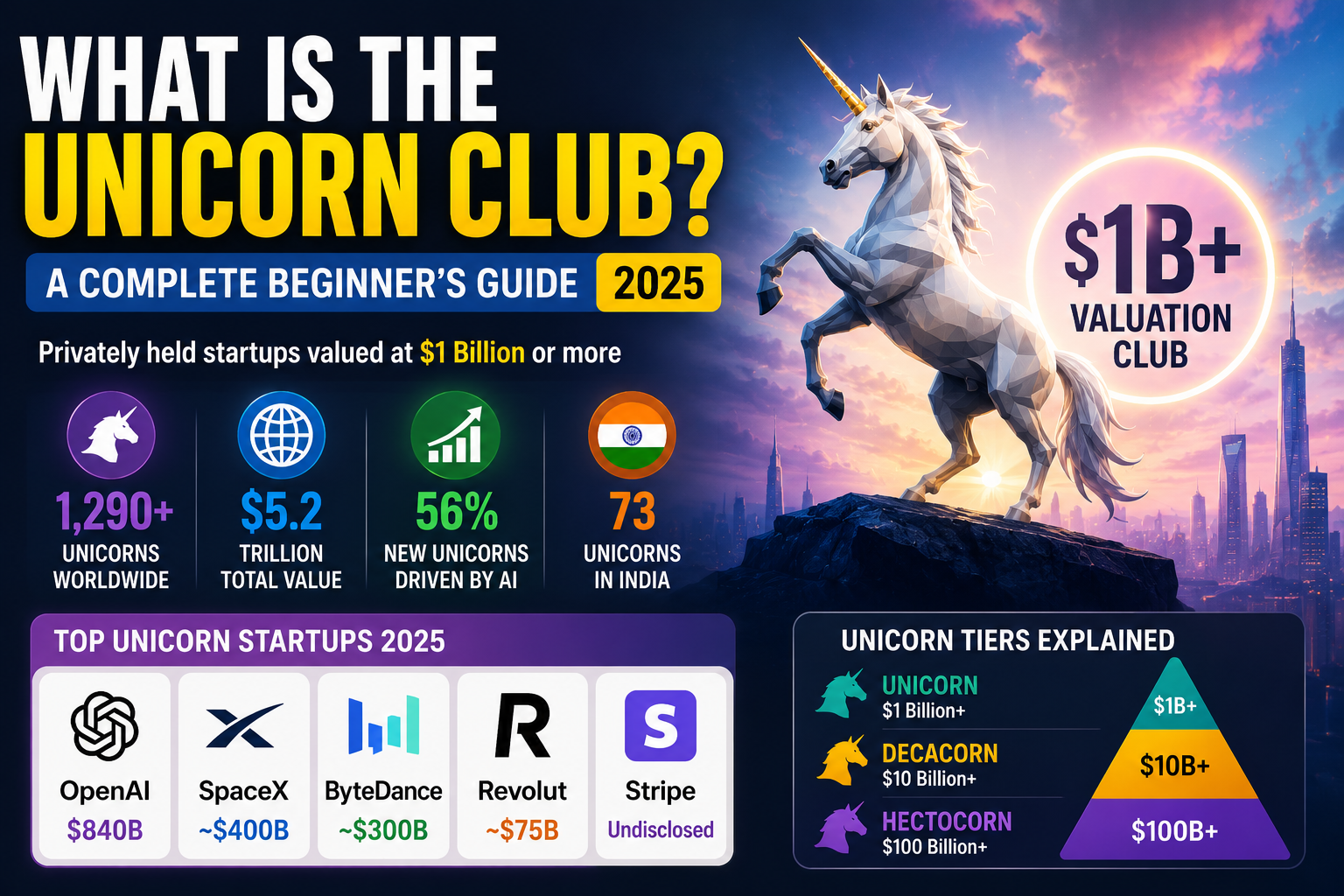
The Unicorn Club refers to privately held startups valued at $1 billion or more. As of 2025, there are between 1,290 and 1,577 unicorns worldwide, worth a combined $5.2 trillion. Yet less than 1% of venture-backed startups ever make it. It is five times more likely to get into Stanford, Harvard, or MIT than to found a unicorn.
What Is the Unicorn Club? The Origin Story Most People Don’t Know
The term was coined on November 2, 2013, by Aileen Lee, founder of Cowboy Ventures, in her landmark TechCrunch article “Welcome to the Unicorn Club: Learning from Billion-Dollar Startups.” She identified just 39 US software companies that had surpassed $1 billion in valuation – roughly 0.07% of all venture-backed startups at the time.
Lee chose the word “unicorn” deliberately: “We like the term because to us, it means something extremely rare, and magical.” Back then, only four new unicorns were born per year on average, and Facebook stood alone as the original super-unicorn at over $100 billion.
In her January 2024 follow-up, the picture had changed dramatically. US unicorns grew 14x – from 39 to 532. But 93% were “Papercorns” (never exited), and 60% were “ZIRPicorns” last valued during the low-interest-rate boom of 2020–2022.
(embed here LinkedIn post) https://www.linkedin.com/posts/sachawunschvincent_global-unicorn-valuation-reaches-usd-52-activity-7425116021000364032-w4D0
What Is a Unicorn? Full Definition and the Complete Startup Tier List
A unicorn startup is a privately held, VC-funded tech company valued at $1 billion or more. The valuation is based on the most recent funding round – not real market performance. As Aileen Lee noted, it is “a convenient but imperfect, impermanent measure of success.”
As the ecosystem has grown, so has the terminology:
| Tier | Valuation | Real-World Example |
| Soonicorn | Expected $1B+ | Pre-unicorn stage startups |
| Unicorn | $1 billion+ | Stripe, Razorpay |
| Decacorn | $10 billion+ | Revolut ($75B) |
| Hectocorn | $100 billion+ | OpenAI ($840B) |
OpenAI at $840 billion is now widely considered the world’s first true Hectocorn – redefining what private market scale can look like.
Welcome to the Unicorn Club 2026 – The Latest Global Numbers
Global unicorn counts in 2025 range from 1,290 to 1,577 depending on the source, with a combined valuation of roughly $5.2 trillion – up 37% from $3.8 trillion in 2022. CB Insights tracked 1,345 unicorns as of May 2026.
The US leads with 712 unicorns worth $2.9 trillion – 55% of the global total. China follows with 157, and India ranks third with 69 to 73 unicorns.
| Country | Unicorns in 2025 | Total Valuation |
| United States | 712 | $2.9 Trillion |
| China | 157 | $687 Billion |
| India | 69–73 | $164 Billion |
| United Kingdom | 53–55 | $190 Billion |
| Germany | 32 | $86 Billion |
| France | 29 | $72.9 Billion |
| Israel | 25 | $47.4 Billion |
| Canada | 22 | $57.5 Billion |
AI is now the dominant force – accounting for ~56% of new unicorns and ~65% of total valuation between 2021 and 2025. Companies post-2011 now average just five years to reach unicorn status, down from ten years before 2012.
(embed here Twitter/X post) https://x.com/Inc42/status/1956596101726789828
What Is an Example of a Unicorn Startup? The Most Valuable in 2026
Seven of the world’s top 10 most valuable unicorns are American. OpenAI leads at $840 billion – the first company ever to reach Hectocorn status while still private. SpaceX follows at ~$400 billion, one of 350 solo-founder unicorns globally.
| Rank | Company | Valuation | Industry |
| 1 | OpenAI | $840 Billion | Artificial Intelligence |
| 2 | SpaceX | ~$400 Billion | Aerospace |
| 3 | ByteDance | ~$300 Billion | Social Media |
| 4 | Revolut | ~$75 Billion | FinTech |
| 5 | SHEIN | ~$66 Billion | E-Commerce |
| 6 | Anthropic | Undisclosed | AI |
| 7 | Stripe | Undisclosed | FinTech |
| 8 | Databricks | Undisclosed | Enterprise AI |
| 9 | xAI | Undisclosed | AI |
| 10 | Canva | ~$32 Billion | SaaS |
The fastest unicorn ever? Safe Superintelligence – under one year. The slowest? Kiteworks – 24 years. Stanford GSB research shows most companies hit unicorn status between three and seven years after their first VC round, with the peak at year four.
What Is the Unicorn Club in India? A Rising Force With 73 Unicorns and Counting
India ranks third globally with 69 to 73 unicorns worth $164 billion. In 2025 alone, 11 new startups joined the club – including Netradyne, Porter, Drools, Fireflies.ai, and Jumbotail – bringing the total to 73, per the Hurun India Unicorn Report.
(embed YouTube video here) https://www.youtube.com/watch?v=qg-2VIu_YAw
India’s speed records are remarkable. Mensa Brands reached unicorn status in six months – the fastest in India’s history. GlobalBees followed in seven months. The active investor base has grown from 188 in 2021 to over 1,000 today, with family offices now playing a major role.
Bengaluru is India’s unicorn capital, home to Zerodha, Razorpay, Groww, Zepto, InMobi, and Meesho.
| Rank | Company | Valuation | City | Sector |
| 1 | Zerodha | $8.2 Billion | Bengaluru | FinTech |
| 2 | Lenskart | $7.5 Billion | Gurugram | E-Commerce |
| 3 | Razorpay | $7.5 Billion | Bengaluru | FinTech |
| 4 | Groww | $7.0 Billion | Bengaluru | FinTech |
| 5 | Zepto | $5.9 Billion | Bengaluru | E-Commerce |
| 6 | OfBusiness | $5.0 Billion | Gurugram | Enterprise Services |
| 7 | InMobi | $5.0 Billion | Bengaluru | AdTech |
| 8 | Icertis | $5.0 Billion | Bellevue (USA) | SaaS |
| 9 | OYO | $5.0 Billion | Gurugram | Hospitality |
| 10 | Meesho | $3.9 Billion | Bengaluru | E-Commerce |
India’s Startup India initiative helped structure this growth, while overall unicorn valuations jumped 80% to over ₹5 lakh crore. New sectors gaining ground include AI, clean energy, space tech, and agritech.
The Dark Side – Is the Unicorn Club Losing Its Magic?
Behind the growth numbers, a sobering story is emerging – one most beginner guides skip entirely.
Aileen Lee’s 2024 follow-up introduced terms that have since gone viral in VC circles: “Zombiecorns” (alive but unable to raise or exit), “Unicorpses” (collapsed former unicorns), and “ZIRPicorns” (valued during the cheap-money era of 2020–2022).
The data is hard to ignore. Around 40% of unicorns now trade below $1 billion in secondary markets. Only 7% of US unicorns have successfully exited, down from 66% in 2013. Just 3% are publicly traded today versus 41% a decade ago. A Harvard survey found 91% of VCs believe unicorns are overvalued. Enterprise capital efficiency has dropped from 26x to 7x.
Lee’s own warning: “Valuation is a convenient but imperfect, impermanent measure of success. Becoming a unicorn too early might even be a curse.”
Yet she also sees opportunity ahead: “We see miles of green fields for more unicorns in years to come.”
So when you hear a company called a unicorn – does that label still carry the weight it once did?
How to Join the Unicorn Club – What the Data Actually Says
Aileen Lee’s original research on 39 unicorns revealed a clear pattern – and it challenges most startup myths.
The average unicorn founder is 34 to 35 years old at founding. Between 83% and 90% had co-founders – typically three – and 90% of those teams had years of prior history together from school or work. Nearly 80% included someone who had previously founded a company.
Geography still matters but is shifting. The Bay Area’s share of US unicorns fell from 69% to 45%; NYC grew from 11% to 19%. Enterprise now produces 78% of unicorns, up from just 38% in 2013. Stanford GSB data shows it takes an average of 4.5 years after the first VC round to reach unicorn status, with a median of seven years from founding.
(embed here LinkedIn post) https://www.linkedin.com/posts/ilyavcandpe_how-long-does-it-take-to-reach-unicorn-status-activity-7399114707049230337-tHRN
The CB Insights Unicorn Tracker is the most reliable tool to track current unicorn status. For the full origin story, read the original 2013 TechCrunch article by Aileen Lee, and for the updated view, the Cowboy Ventures 10-year follow-up is essential reading.
Final Thoughts – Welcome to the Unicorn Club, Where Only the Elite Survive
The Unicorn Club is a real, data-backed designation for a small group of private companies reshaping the global economy. The US leads with 712 unicorns worth $2.9 trillion. India is surging with 73 and counting. AI is driving the next wave. And while critics question whether the $1 billion label still means what it used to, the scale of innovation inside this club says the story is far from over.
Whether you’re an investor, founder, or simply curious – understanding the Unicorn Club means understanding where the future is being built.
Which unicorn startup do you think will go public next? Drop your pick in the comments below.
Disclaimer: The statistics, valuations, and data referenced in this article are sourced from publicly available reports including CB Insights, PwC Global Unicorn Report, Hurun Global Unicorn Index 2025, NDTV, Indian Express, and Stanford Graduate School of Business research, as reported through 2025. Unicorn valuations are based on the most recently reported private funding rounds and are subject to change. This article is intended for informational and educational purposes only and does not constitute financial, investment, or legal advice. Readers should conduct their own due diligence before making any financial decisions.