


If you are still using Chrome or Safari just out of habit, 2026 might be the right time to reconsider. This year has brought some real shifts in the browser world – AI-powered browsers, stronger privacy tools, and a major antitrust ruling against Google have together made the competition more interesting than it has been in years.
Chrome still holds over 70% market share, but its desktop numbers have been slipping. Edge, Firefox, and Brave are all growing. For the first time in a long while, it feels like Chrome’s dominance might actually be challenged.

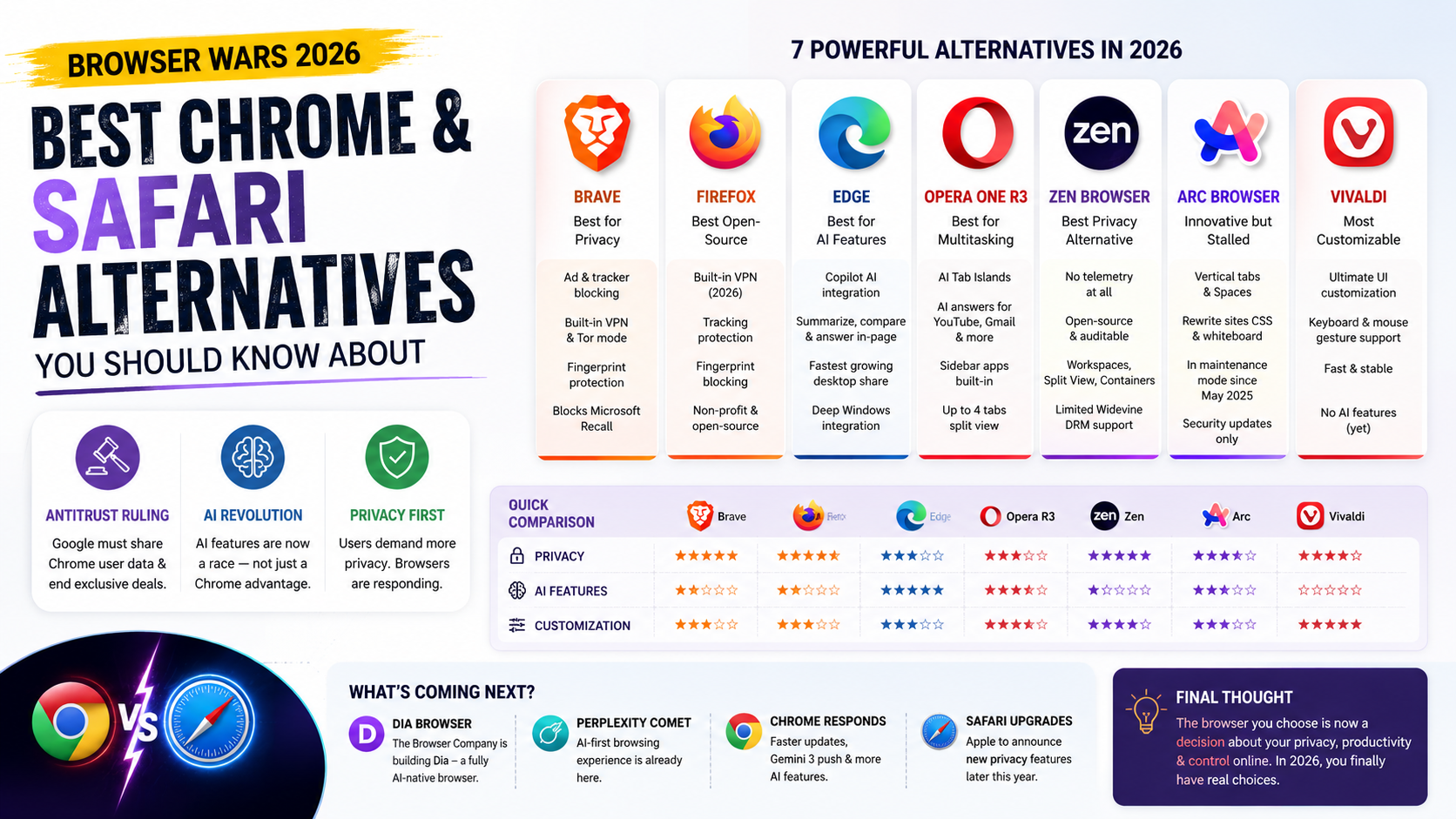
Why Is This Happening Now?
Three things are driving the change.
First, a US court ruled in 2025 that Google had maintained an illegal search monopoly. Chrome was not forced to be sold, but Google now has to share Chrome user data with competitors and can no longer sign exclusive deals that block rival browsers from devices.
Second, the AI race has heated up. Chrome added Gemini 3, but Brave, Edge, and Opera already had AI features built in. A new browser called Perplexity Comet has also entered the market with AI at its core.
Third, people are genuinely more privacy-conscious now. Apple even released a new Safari ad directly targeting Chrome users, and more privacy features are expected later this year.
7 Best Alternatives Right Now
1. Brave – Best for Privacy
If privacy matters to you, Brave is the one. It blocks ads, trackers, and third-party cookies by default. There is a built-in VPN, a Tor mode for anonymous browsing, and fingerprint protection that changes your browser signature every session. In 2026, Brave also started blocking Microsoft Recall from taking screenshots of your browsing. No data is collected or sold. It is the most privacy-focused mainstream browser available.
2. Firefox – Best Open-Source Browser
Mozilla is a non-profit, so there is no incentive to sell your data. Firefox 149 in March 2026 added a free built-in VPN, along with tracking protection and fingerprint blocking turned on by default. After years of losing users, Firefox is growing again – and its 2026 upgrades are a big reason why.
3. Microsoft Edge – Best for AI Features
For Windows users, Edge has become genuinely impressive. A May 2026 update brought advanced Copilot AI that can scan your open tabs, summarize pages, compare products across sites, and answer questions without you leaving the page. Its desktop market share grew faster than any other browser this year. If you are already in the Microsoft ecosystem, Edge gives you something Chrome simply cannot match right now.
4. Opera One R3 – Best for Multitasking
Opera’s January 2026 release rebuilt its AI engine from scratch, making responses 20% faster. Its standout feature is Tab Islands, which uses AI to keep related tabs grouped without them interfering with each other – no other browser does this yet. You can also ask questions about YouTube videos without watching them, Gmail and Calendar are built into the sidebar, and you can run up to four tabs in split view simultaneously. Great for heavy multitaskers.
5. Zen Browser – Best Privacy-Focused Alternative to Arc
Zen runs on Firefox’s engine with all telemetry completely removed. It collects no IP addresses, no browsing history, and installs no trackers. Because the code is fully open-source, anyone can audit exactly what it does. It has Workspaces, Split View, Container Tabs, and a clean layout inspired by Arc. The one downside is limited Widevine DRM support, so some streaming services may not work properly. Still, for anyone who wants verifiable privacy, Zen is hard to beat.
6. Arc Browser – Innovative but Stalled
Arc is one of the most creative browsers ever built – vertical tabs, organized Spaces, the ability to rewrite any website’s CSS, a built-in whiteboard tool. However, Arc entered maintenance mode in May 2025. No new features are being added. The team has shifted focus to building Dia, a completely new AI-native browser. Arc still gets security updates and works well, but starting fresh with it in 2026 is not something I would recommend.
7. Vivaldi – Most Customizable Browser
Vivaldi has under 1% market share, but its users are intensely loyal. You can customize almost everything – tab placement, toolbar layout, keyboard shortcuts, mouse gestures, color themes. It is fast and stable. There are no AI features and it does not lead on privacy either, but for power users who want complete control over their browsing environment, nothing else comes close.
Quick Comparison
| Browser | Best For | Privacy | AI Features |
| Brave | Privacy | ⭐⭐⭐⭐⭐ | Basic |
| Firefox | Open Source | ⭐⭐⭐⭐⭐ | Basic |
| Edge | AI / Windows | ⭐⭐⭐ | ⭐⭐⭐⭐⭐ |
| Opera R3 | Multitasking | ⭐⭐⭐ | ⭐⭐⭐⭐ |
| Zen | Privacy + OSS | ⭐⭐⭐⭐⭐ | Basic |
| Arc | Productivity | ⭐⭐⭐⭐ | ⭐⭐⭐ |
| Vivaldi | Customization | ⭐⭐⭐⭐ | None |
What is Coming Next?
The Browser Company is building Dia, described as a fully AI-native browser that rethinks browsing from the ground up rather than just adding AI on top. No release date yet, but it is the reason Arc was put into maintenance mode.
Perplexity Comet is already in the market, blurring the line between search and browsing by making AI the default starting point. Chrome is responding by speeding up its release cycle and pushing Gemini 3 harder. Apple is expected to announce more privacy features for Safari later this year.
Final Thoughts
Chrome is not going anywhere. But the alternatives have never been stronger, and the reasons to switch have never been more real.
If privacy is your top priority, go with Brave. If you want deep AI integration on Windows, Edge is genuinely ahead of Chrome right now. If open-source principles matter to you, Firefox in 2026 is worth a second look. And if you just want complete control over every detail of your browser, Vivaldi is in a league of its own.
The browser you use is no longer just a window to the web. It is a choice about who gets to see what you do online. In 2026, for the first time in over a decade, that choice actually feels meaningful.