NVIDIA’s AI Empire: How Its Startup Investments Are Shaping the Future
When we talk about the AI revolution in 2025, one name dominates the conversation — NVIDIA. From powering ChatGPT-like models to fueling robotics, healthcare, and autonomous cars, NVIDIA’s AI empire has grown into the backbone of the modern digital economy. But what makes it even more fascinating is how aggressively it’s investing in AI startups, ensuring the next generation of innovation doesn’t just use NVIDIA’s chips, but thrives on them.

Why NVIDIA’s AI Empire Matters
NVIDIA isn’t just a GPU company anymore. Its hardware and software ecosystem — CUDA, DGX servers, and AI platforms — has become the foundation of AI development. Every startup building AI-powered solutions, from generative AI to self-driving cars, often depends on NVIDIA’s technology.
And here’s the key point: NVIDIA is not just selling hardware. It’s investing in startups, nurturing them, and strategically making sure it stays at the center of AI’s growth.
Think of NVIDIA like a landlord in the AI city — not only renting out the land (GPUs), but also financing new buildings (startups).
NVIDIA’s Investment Strategy
NVIDIA invests through multiple channels:
- NVentures – Its official venture capital arm.
- Partnerships – Collaborating with incubators and accelerators.
- Direct funding – Supporting startups in healthcare, robotics, autonomous vehicles, and generative AI.
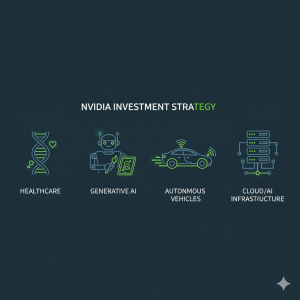
Some sectors it has shown interest in include:
- Healthcare AI – Startups using AI for drug discovery and diagnostics.
- Generative AI – Companies building creative tools for text, video, and 3D modeling.
- Autonomous Systems – Robotics and self-driving vehicle startups.
- AI Infrastructure – Cloud platforms and data optimization solutions.

Real-World Startup Examples Backed by NVIDIA
Several startups have already benefited from NVIDIA’s empire-building investments:
- Runway ML – A generative AI video platform that went viral with its creative tools.
- Recursion Pharma – Leveraging AI and NVIDIA’s technology to accelerate drug discovery.
- Figure AI – A robotics company working on human-like AI-powered robots.
- Synthesia – Known for AI video avatars, built in partnership with NVIDIA technology.
These are just a handful of companies shaping the AI landscape with NVIDIA’s support. Each represents how NVIDIA is strategically placing bets on industries that will define the next decade.
How This Impacts You
NVIDIA’s startup investments are not just industry news — they have a direct impact on professionals, students, and businesses.
- If you’re a developer, NVIDIA’s ecosystem is likely where you’ll build the next generation of applications.
- If you’re an investor, following NVIDIA’s startup bets could reveal the next unicorn company.
- If you’re a student or professional, careers in AI are booming thanks to these investments and partnerships.
- If you’re a business owner, the startups NVIDIA supports may soon provide tools that transform your daily operations.
This isn’t just about stock prices or Silicon Valley buzz. It’s about the real-world tools and technologies that will shape how you live, work, and learn in the future.

The Bigger Picture: NVIDIA’s Moat
By investing in startups, NVIDIA ensures:
- Demand Lock-In: Startups that scale will inevitably buy more NVIDIA GPUs.
- Early Access: NVIDIA gets a front-row seat to disruptive technologies before competitors.
- Ecosystem Dominance: It controls both the tools and the talent pipeline.
The strategy is similar to how Apple invested in developers when the iPhone first launched. That early support created an entire app economy that fueled Apple’s growth for years. NVIDIA is now doing the same with AI.
Critics and Concerns
Of course, not everyone views this growth without caution. Some analysts argue that NVIDIA is becoming too dominant, raising concerns about monopolistic control in the AI space. Smaller startups may struggle if they don’t align with NVIDIA’s ecosystem, creating questions about competition and innovation diversity.
There’s also an ethical dimension. As AI becomes more powerful, critics argue that NVIDIA and its portfolio companies must take responsibility for how these technologies are deployed — especially in areas like surveillance, defense, and deepfake creation.

Conclusion: The Future NVIDIA is Building
The story of NVIDIA’s AI empire is not just about graphics cards or stock valuations. It’s about how one company is shaping the future of intelligence itself. By investing in startups, NVIDIA ensures the AI revolution is not only powered by its hardware but also accelerated by a new wave of innovators.
For you as a reader, this means the applications you’ll use, the tools you’ll rely on at work, and even the healthcare treatments you or your family may receive in the coming decade could all be born inside NVIDIA’s empire.
The AI future isn’t on the horizon anymore — it’s already here. And NVIDIA is ensuring it holds the keys to what comes next.