


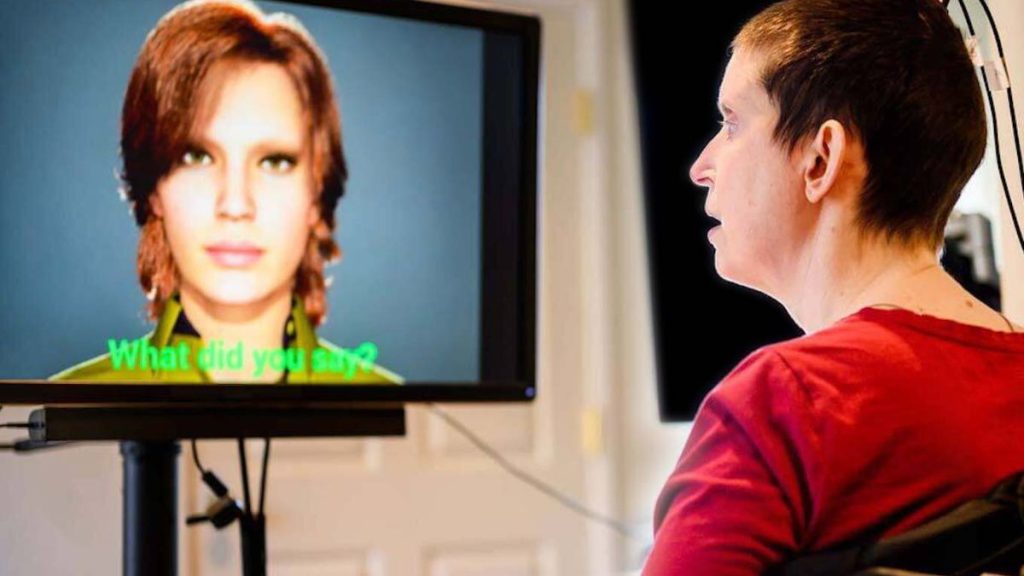
In a remarkable medical advancement, researchers in California have developed an AI-powered system that restores natural speech for paralyzed individuals—using their own voices. This breakthrough, achieved by teams at UC Berkeley and UC San Francisco, was demonstrated in a clinical trial involving a patient who is severely paralyzed and unable to speak.
The new system marks a significant leap in the field of brain-computer interfaces (BCIs), outperforming previous efforts by converting brain signals into audible speech with greater precision and realism.
How It Works
The technology relies on high-density electrode arrays that record activity directly from the brain’s surface, alongside microelectrodes that penetrate the cortex and facial surface electromyography sensors. These tools capture the brain’s motor cortex signals—the area responsible for speech. AI then decodes this data into spoken words.
According to study co-lead Cheol Jun Cho, the neuroprosthesis intercepts and processes the neural signals before they translate into motor movements, enabling accurate speech synthesis.
Key Advancements
-
Real-time speech synthesis: The model decodes brain activity in 80-millisecond increments, delivering near-instant speech, a capability likened to virtual assistants like Alexa and Siri.
-
Naturalistic communication: The system enables more expressive and fluent speech, moving closer to the rhythms of natural human interaction.
-
Voice personalization: AI is trained using recordings of the patient’s voice before their injury, producing speech that mirrors their natural tone and manner.
-
Improved speed and accuracy: Speech decoding begins within one second of attempted speech—down from eight seconds in similar past studies.
Overcoming Challenges
One of the biggest hurdles was creating speech output for patients with no remaining vocalization. Researchers solved this by employing a pre-trained text-to-speech model combined with the individual’s pre-injury voice data to reconstruct natural-sounding speech.
Impact and Future Directions
The innovation promises profound improvements in the lives of individuals with conditions like ALS or paralysis, offering them a way to speak, connect, and express complex ideas with their own voice.
UCSF neurosurgeon Edward Chang noted the rapid progress: “It is exciting that the latest AI advances are greatly accelerating BCIs for practical real-world use in the near future.”
Future developments aim to refine the AI’s responsiveness, enhance expressiveness, and introduce variations in tone, pitch, and loudness—further closing the gap between synthetic and human speech.
Kurt’s Key Takeaways
What sets this breakthrough apart is its goal of restoring not just speech, but the individual’s own voice. It’s a major step forward, offering renewed hope for communication and connection among those who have lost the ability to speak.
Want more updates on groundbreaking tech innovations that are changing lives? Visit our website for the latest developments in AI, neurotechnology, and beyond.
Disclaimer: The information presented in this article is based on ongoing research and clinical trials. Results may vary for individual patients, and further validation is required before widespread clinical use. Please consult medical professionals for personalized advice.